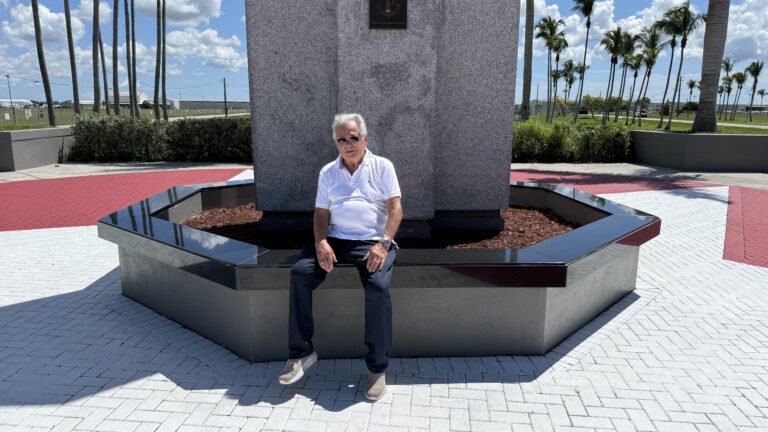
Captain Amado Cantillo stands in the heat of the Miami sun, staring at a single sheet of paper in a manila file folder and shaking his head. “Every time I read it–and I read it over and over again–I get upset.”
Cantillo is the president of the Cuban Pilots Association (CPA) and the driving force behind the Bay of Pigs Air Memorial at Miami Executive Airport, formerly known as Kendall-Tamiami Executive Airport. Built to honor the 10 Cuban and 4 American pilots of Brigade 2506 who lost their lives in aerial combat at Bahía de Cochinos on April 17, 1967, the focal point of the small memorial site is a B-26 bomber painted like the planes used during the invasion. And 15 years after its unveiling, Cantillo is still fighting to secure the financial support needed to maintain the memorial in the condition the fallen soldiers deserve. Cantillo has been able to fund the site’s construction and maintenance over the years thanks to his own resourcefulness and the generosity of others, especially those in the Cuban expat community.
As Cantillo points out, “To do a little bit costs a lot. Sometimes I don’t sleep. I’m a champion sleeper, but I haven’t slept in the last six months.” Looking pensive behind the lenses of his trademark aviator sunglasses, he adds, “I don’t like to owe money–especially because this is a sacred place.”
A white-haired man in his ‘80s, you might not be able to guess Cantillo’s past by looking at him. But he has seen more than his fair share of combat. Before his years working in Miami-Dade County Mosquito Control and Habitat Management for the Department of Aviation, he was recruited by the CIA and trained in Vieques, Puerto Rico, for the 1961 Bay of Pigs invasion of Cuba. Under the command of American soldier and CIA officer Grayston Lynch, Cantillo led a group of frogmen who were scheduled to land at a site called Blue Beach. But almost nothing went according to plan, and even 60 years later, there are still disagreements over where to lay blame for the failed operation.
One thing remains clear: Though the operation failed, the men of Brigade 2506 did not. “We call ourselves brothers,” Cantillo says. “We don’t call ourselves comrades like they do, compañeros. We call ourselves brothers.” And Cantillo realized that his brothers weren’t getting the recognition they deserved for sacrificing themselves in a fight others destined them to lose. “When they came back, they just, it was just them.”
His new mission? Make sure those with whom he fought are honored in a manner befitting their service.
The B-26 at Miami Executive Airport is 84 years old, and while it flew in several wars, this particular plane wasn’t one of the 16 that participated in the Bay of Pigs invasion. It saw combat in Europe, then Korea, and then was used in California for firefighting. Like the actual planes that flew at the Bay of Pigs, this one is painted to mimic the aircraft of the Cuban Airforce–a tactic meant to allay suspicion during the invasion. This particular plane was hand-painted by Lorenzo Suarez, who helps with upkeep at the memorial five days a week and who, Cantillo points out, “doesn’t like stencils.” The cement floor of the memorial is also painted beautifully to create the image of a waving Cuban flag. But when Cantillo first leased the area from the County, it was just empty space–and he had to figure out how to find a plane and bring it over.
Plans for the memorial were first announced in August 1999, after Cantillo’s realization that there were already monuments for infantrymen and for the Navy who fought at the Bay of Pigs, but none for the Liberation Air Force of Brigade 2506. Cantillo reached out to a good friend, General Perez, who introduced him to Major General Charles D. Metcalf, former director of the National Museum of the United States Air Force. Cantillo flew to Ohio to meet with Metcalf. “I could talk to that guy for days. That’s how it started. He said, ‘I’ve got an airplane for you.’”
Unfortunately for Cantillo, the plane was not in Miami but in California, and he simply did not have the funds to fly over to see it in person. (In fact, he had to borrow money to fly to the meeting in Ohio.) In one of many shows of generosity and faith in Cantillo’s mission, the Major General offered him a first-class ticket to California and said a sergeant would be waiting there to show him the aircraft.
After making the trip and deciding he wanted the plane, the next hurdle was figuring out how to bring it to Miami. Cantillo was working on a plan that involved eight Cubans and a few tractor-trailors, but they lacked the tools and the experience to transport such a large machine. Again, Major General Metcalf came to Cantillo’s aid, saying he had someone who could do it for him. Cantillo scrounged up the money to transport the plane and waited.
Then, one day as he was training a helicopter pilot, Cantillo got a call that the plane had arrived. He thought it would take the three men who brought it over at least a week to put together, but it was done in fewer than three days.
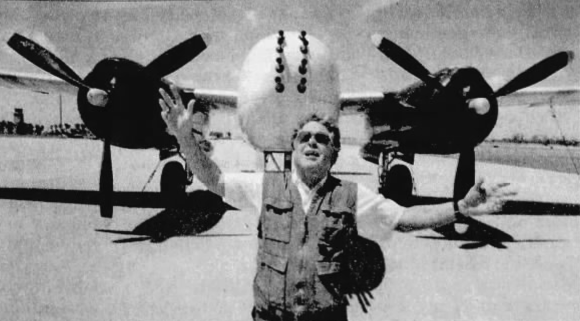
The plane initially sat at the north side of the airport but was eventually towed to the memorial site, where it was parked with no marker, just blocks. But Cantillo was quickly met with another obstacle, this time in the form of a woman attempting to block any further progress with the project. He explains that the woman was “someone in the fiscal department somewhere in Florida, and she was blocking construction because we are related to Brothers to the Rescue, and groups that make waves in Cuba.” It was then that an iconic picture was captured. In the photo, Cantillo’s outstretched arms encapsulate his frustration and despair at yet another complication. “And I say, ‘Oh man, I can’t take anymore.’ I’m praying, ‘God, help me!’ And the truck goes by and takes that picture.”
CHARLES TRAINOR JR. / MIAMI HERALD STAFF
As he would many times in the years ahead, Cantillo relied on his determination and his community connections to clear this latest roadblock. Part of navigating the situation involved writing a letter confirming that the aircraft was for display only. Not long after the photo was taken, he got a call from the County that he was clear to proceed. He was one step closer to his goal.
Alongside the plane, the memorial features a wall with two flagpoles and multiple plaques bearing the names of Brigade 2506, key contributors to the project, and photos of the 14 pilots who were killed in the invasion. There is also a large pillar that was designed by an architect who worked pro bono and refused any formal recognition at the site.
“I had more or less an idea of what I wanted–pointing toward Cuba,” says Cantillo. The blackboard on one side of the monument, which cost $12,000, was also donated. “I didn’t have the money. The architect said, ‘Whatever.’ We ran out of this–’Whatever.’” The architect is yet another member of the community whose support and generosity made the memorial possible. Today, organizations like Preference Consulting have continued to show their support by creating a detailed 3D scan showing every aspect of the site, from the B-26’s flight instruments to a bird’s eye view of Cuban-flag-shaped flooring, digitally preserving the memorial and allowing people from even far away to see a piece of history.
Walking through the site, Cantillo shares details about some of the other donors whose names he was able to include on the plaques. As evidenced by the existence of the monument itself, paramount to Cantillo is giving credit where credit is due.
“I try to recognize everybody,” he says, pointing to the different names. “This senator, Senator Javier Soto, helped us a lot.” A little further along, he adds, “These are the two mechanics who went on shore with the brigade.” The B-26s of the Liberation Air Force were meant to land, refuel, restock ammunition, and take off again, but this never happened. The mechanics were killed on the ground, fighting.
As he ambles, Cantillo turns to the many issues at the site that need repair, issues that might not be immediately apparent to a tourist appreciating the memorial, but which become clear once pointed out. The marble underneath one flagpole is breaking, with the crack extending all the way to one of the plaques. Faded photos of the deceased pilots have been suffering under the Florida sun.
Cantillo continues. “I’ve got so much to do here. Everything’s expensive. The sun and the weather here, it’s terrible.” He points to another plaque that needs to be replaced but costs about two thousand dollars. To paint the airplane alone costs between sixty and eighty thousand dollars. Instead of paying that amount, Cantillo and Lorenzo did it themselves (“Especially Lorenzo.”). Cantillo replaced the canopy for $12,000, an astonishingly low amount given that one place in Texas wanted $36,000 for the job, while another in Hawaii wanted $40,000, including transportation and insurance. As Cantillo puts it, “Everything costs.”
Though there were 280 people in the Cuban Pilots Association when he was elected president in 1988, there are now only 7. “I haven’t resigned. I got upset, and I told them I would resign. But I’ll die here.”
It’s been almost 40 years since Cantillo started his journey to create the Bay of Pigs Air Memorial at Miami Executive Airport, a journey he knows would have been impossible without the support of his friends, his fellow Brigade members, and the local community. Though he first acquired the B-26 in the mid-1980s, he wasn’t able to bring it to Miami until 1990. Wasn’t able to secure land for the memorial until 1999. Wasn’t able to construct it until the 2000s. And through all the difficulties and delays, the chief force propelling the project forward has been the Captain’s perseverance and determination not to let these 10 Cuban and 4 American pilots–”brothers to the end”–be forgotten.
For now, Cantillo just wants to continue to honor the pilots of Brigade 2506. Much like his own participation in the Bay of Pigs, in his view, it’s just something he has to do. “I’m not a hero. I’m not anything. I just did my duty.”